Carryover Notes

Free SOAP note template for speech therapy

A one-page SOAP template for school sessions, plus three filled-in examples you can borrow wording from: articulation, expressive language and social communication.

US Letter PDF. No sign-up and no email address. Free to copy and share with your team.

A SOAP note on a clipboard, filled in by hand for an articulation session.

What goes in each box

Your district or state Medicaid program may ask for specific details, such as minutes, individual or group service, and the goal addressed. The template has spaces for those at the top; it’s worth checking your own requirements first.

Subjective

What the student, teacher or parent reported, and how the student presented. A sentence or two is plenty.

“Reported practicing /s/ words with his sister twice this week.”

Objective

What you measured: target and level, number of trials, accuracy and cue level. Someone else could check it against your data sheet.

“Final /s/ at word level: 15/20 (75%) with minimal visual cues.”

Assessment

What the numbers mean, compared with last session and with the goal criterion, plus any error patterns. This is where your clinical judgment goes.

“Up from 60% last session; most errors were in /s/ blends.”

Plan

What happens next: continue, change the level or the cueing, add home practice, or check in with the teacher.

“Move to phrases once independent accuracy reaches 70% in two sessions.”

Three filled-in examples

Borrow any wording that fits. The students are made up.

Articulation: initial /r/

S

Student reported reading his /r/ word list at home on three days this week. Teacher noted he is self-correcting /r/ during class reading.

O

Produced initial /r/ at word level with 65% accuracy independently (13/20) and 85% given minimal verbal cues (17/20). Errors were distortions; no /w/ substitutions observed.

A

Independent accuracy increased from 50% last session to 65%. Cued accuracy has met the 80% criterion in two consecutive sessions. Distortions occurred mainly before back vowels.

P

Continue word level with emphasis on back-vowel contexts; begin phrase level when independent accuracy reaches 75% across two sessions. Send an updated home practice list.
Expressive language: regular past tense

S

Student was eager to retell weekend events. Teacher reported she uses past tense inconsistently in written journals.

O

Used regular past tense -ed in structured sentence completion with 70% accuracy (14/20); 10 of the 14 correct responses were independent and 4 followed a verbal model. In a 2-minute retell, used -ed correctly in 3 of 7 obligatory contexts.

A

Structured accuracy is up from 55% last week, but use in connected speech remains below 50%, so the skill has not yet generalized beyond structured tasks.

P

Continue structured practice and add short retell tasks each session to target generalization. Share a visual reminder card with the teacher for journal writing.

Social communication: topic maintenance

S

Student chose the conversation topic (video games) and said he “likes talking with the group”.

O

In a small-group conversation, maintained a peer-initiated topic for at least three turns in 4 of 6 opportunities; 2 of the 4 required one verbal reminder. Changed topic abruptly twice.

A

Topic maintenance improved from 2 of 6 opportunities last session. He is more successful when the topic is of personal interest; peer-chosen topics remain harder.

P

Continue group conversation practice; introduce a visual topic card and gradually reduce verbal reminders. Target peer-chosen topics in half of the opportunities next session.

Why the template looks like this

  • The accuracy line is printed in the Objective box, so the trial count and the cue level end up in every note without having to remember them.
  • Last session sits beside today, because that comparison is usually the first sentence of the Assessment.
  • Minutes, service type and goals are at the top, since these are the details billing and progress reports tend to ask for.

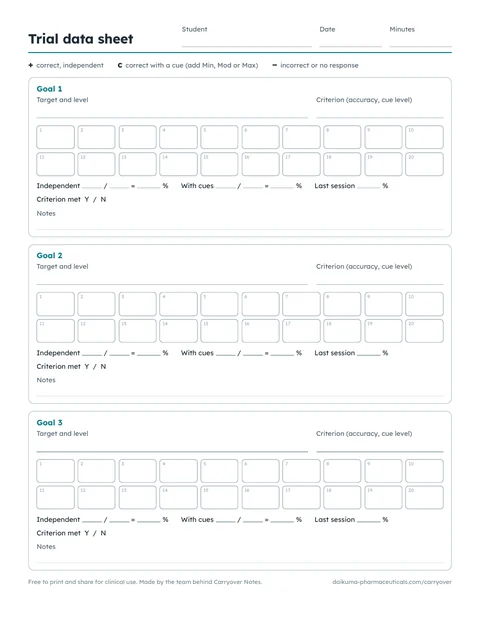
If you take data on our free data sheets, the results line there copies straight into the Objective box here.

SOAP or DAP?

A DAP note (Data, Assessment, Plan) folds Subjective and Objective into one Data section. Some clinicians prefer it because it is shorter, and some districts ask for one format or the other. The content is the same either way: what happened, what it means, and what happens next.

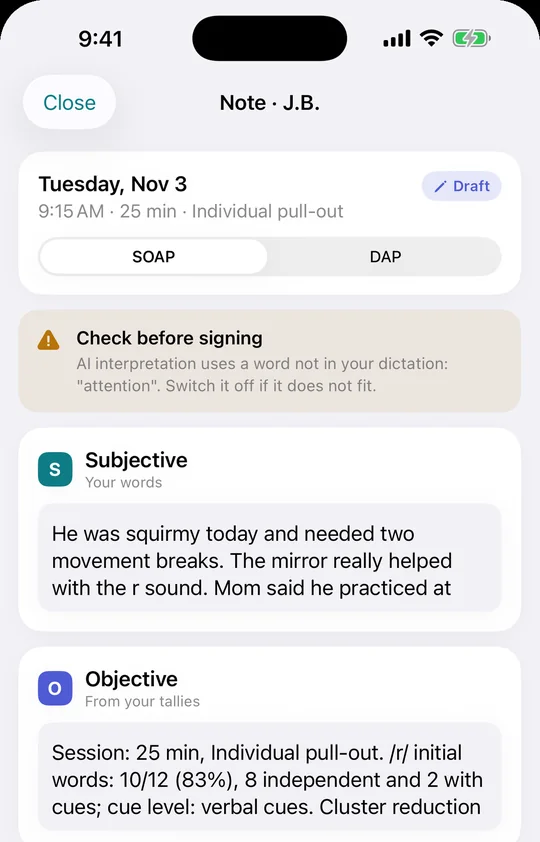
A SOAP note drafted in Carryover Notes, with a reminder to check one sentence before signing

We make Carryover Notes, an iPhone app. The template is free either way.

Or let your iPhone draft the note

In Carryover Notes, the Objective and the comparison with last session come straight from the trial taps you make during the session, so no numbers are written by AI. You dictate the rest for about 30 seconds, and your own sentences are sorted into Subjective and Plan. Anything the AI adds is checked against your words and flagged before you sign.

  • Student data stays on the phone. No account, nothing uploaded.
  • Free for tallies, dictation and notes you write yourself, plus 10 AI note drafts a month.
  • Needs an iPhone with Apple Intelligence (iPhone 15 Pro or later).